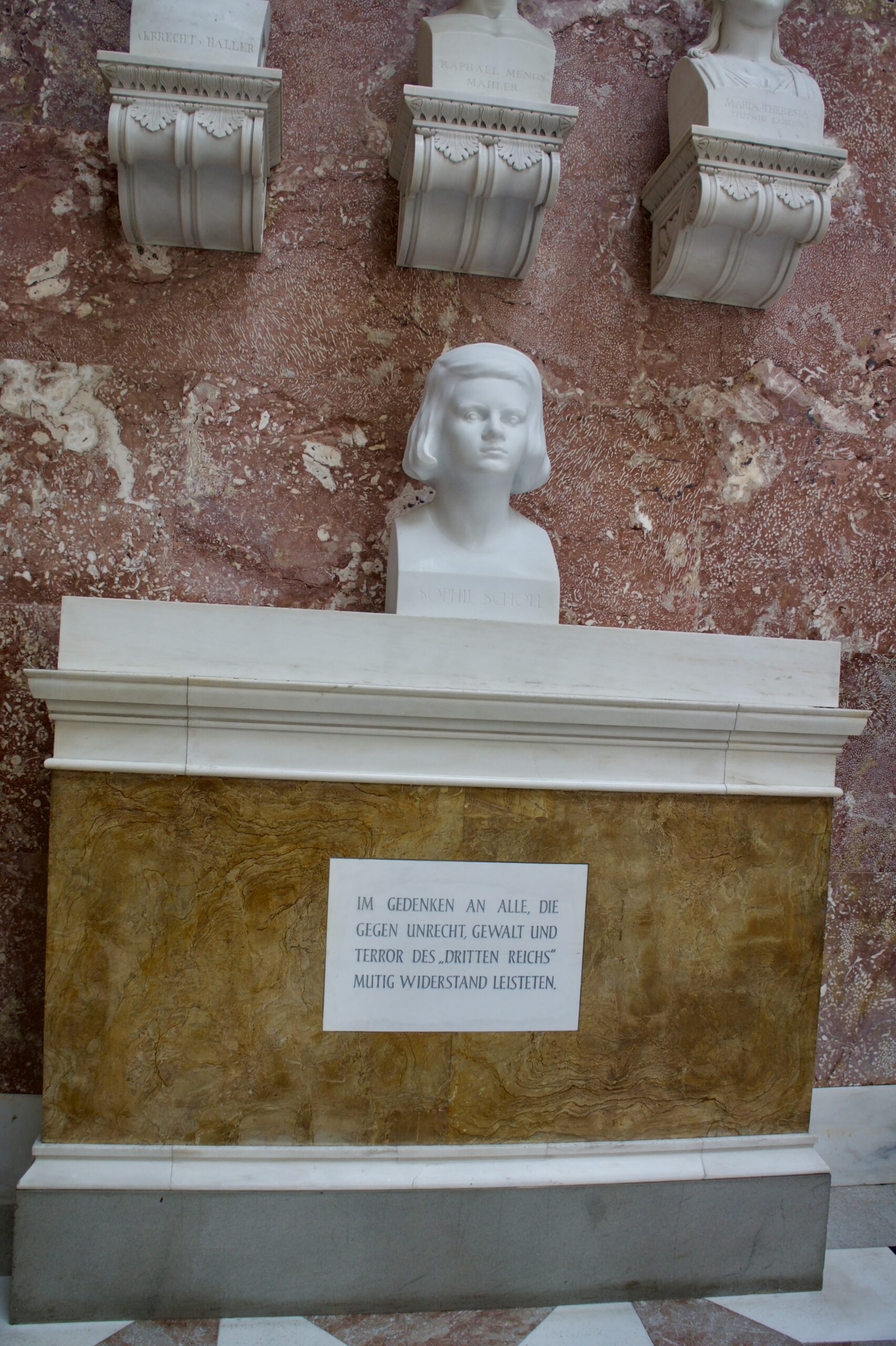
During the ISEE conference, I made time for a trip to Regensburg. Near the city stands the Walhalla. When Dr. Shin suggested we go, I joked that Valhalla was where people went after death. It turned out to be a memorial to distinguished figures from the German-speaking world—a kind of German Pantheon. Walhalla is a vast building in the style of a Greek temple, its interior lined with marble busts. I recognized Beethoven, Wagner, Goethe, Leibniz, Planck, Moltke, Adenauer, and others. But among them, it was the bust of a young woman that caught my eye.
She was one of only a handful of women there. Unlike most of the other busts, which had only a name beneath them, hers stood on a separate pedestal with an inscription. Her name was Sophie Scholl. I could not understand all the German, but I recognized the words Terror des „Dritten Reichs“—the terror of the Third Reich. With the help of a translation app, I read the full inscription: “In memory of all those who bravely resisted the injustice, violence, and terror of the ‘Third Reich.’”
Sophie Scholl was a university student and a member of the White Rose resistance group, which opposed Nazi Germany. She was executed with her brother Hans in 1943.